New manuscript shows how essential promotoras are for improving public health
Investing in promotoras, who serve as bridges between health care and communities, can benefit many facets of health.
“Promotoras de Salud,” or Spanish-speaking community health workers, are essential to educating and equipping local community members with the information and skills they need to live healthier lives. Many Hubs across the country funded by the National Center for Advancing Translational Sciences (NCATS), a center within the National Institutes of Health (NIH), have a community engagement component. This means they take unique approaches to engaging and working with their unique local communities for the purposes of bettering health locally and nationally. They often partner with local organizations to carry out this work, and share best practices to the wider network of Hubs through various dissemination methods including published manuscripts.
A new manuscript published in JAMA Network Open brought together collaborators through the NIH’s Community Engagement Alliance (CEAL) Project, a research network that works with communities and community-based organizations to identify engagement and outreach practices that communicate trustworthy, science-backed information to communities. Collaborators from several California-based universities include USC, Stanford University, UCLA, UC Merced, UCI, UC Davis, and organizations such as Vision y Compromiso, and Cultiva Central Valley. In the manuscript, they outline how promotoras benefit the community; namely, through providing health education, care navigation, and access to essential services. Promotoras are especially beneficial in communities that are low income and rural. Many of the promotoras are working in the communities in which they live, which makes them trustworthy, increases their credibility amongst these populations, and makes them more effective.
The Southern California Clinical and Translational Science Institute (SC CTSI)’s Community Engagement Team housed within the Resources and Services Unit is responsible for establishing and enriching community relationships in the greater Los Angeles area. They focus heavily on populations near the two campuses of the University of Southern California (USC). The catchment areas near the University Park (also known as the “main” campus) and the Health Sciences Campus (near the USC hospitals and medical facilities) contain many different types of people with various needs, and the Community Engagement Team is well positioned to serve them all.
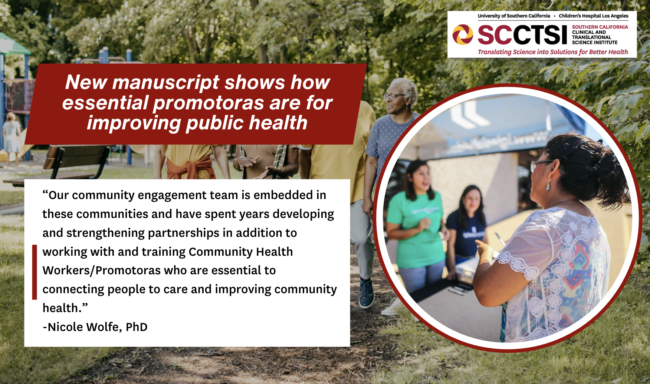
“Our community engagement team is embedded in these communities and have spent years developing and strengthening partnerships in addition to working with and training Community Health Workers/Promotoras who are essential to connecting people to care and improving community health,” said Nicole Wolfe, PhD, Co-Director of the SC CTSI Community Engagement Team. “We are grateful for this collaboration and the opportunity to expand education and training for CHWs to increase their capacity to further strengthen community health."
In terms of impact, promotoras are an evidence-based way to reduce mistrust and help community members navigate complex healthcare and social systems. However, the role is not without its challenges. There are currently inconsistent training and certification standards, limited funding and job stability, lack of recognition and career pathways, and most noteworthy of all, lack of integration into healthcare systems. The authors recommend that these barriers be addressed by standardizing training offerings, expanding sustainable funding such as via Medicaid reimbursement, integrating promotoras better into care teams, providing career development and advancement opportunities, and strengthening policy support at the local and national levels. In turn, this will lead to improved access to care, reduction of health issues, and increased community trust in health systems.
As for future collaborations through CEAL, the CE Team will continue to work with community partners to help them identify how they can better serve their constituents and how the group can develop and implement interventions to reach these goals.