Interview with Dr. Atu Agawu, MD, MPH, MSCE, KL2 award recipient
An interview with a recipient of the SC CTSI Mentored Career Development in Clinical and Translational Science award
Tell us a little bit about your experience so far in the KL2 program.
The KL2 program has been a formative stretch of my early career because of the protected time –having most of my effort devoted to research changed both what I could ask and how deeply I could pursue it. Just as valuable has been the structure around that time: a committed mentorship team, training in translational methods, and a cohort of scholars from different disciplines who became a genuine support system. Together they let me stop squeezing research into the margins and start treating my growth as a scientist as the actual work.
What do you think others can gain from this program?
For clinicians with a research question but limited time to pursue it, the KL2 provides the essential foundation of protected time, structured mentorship, rigorous training, and a peer network that makes the path to independence feel possible. Scholars gain practical research skills, but they also undergo a deeper shift when they begin to see themselves as researchers. That identity formation is one of the program’s most valuable outcomes.
Tell us about your own background as a researcher and gastroenterologist.
I’m a pediatric gastroenterologist with training in public health and clinical epidemiology, including an MPH during medical school at the University of Pennsylvania and later residency, GI fellowship, T32 research training, and a Master of Science in Clinical Epidemiology at the Children’s Hospital of Philadelphia. My early research interests centered on health disparities, but my work has since shifted toward the systems and relationships that shape care for children with complex needs, especially how families, clinicians, and communities sustain treatment at home.
What drove you to specialize in this?
There wasn’t one defining moment. I chose pediatric GI because it fits the way I like to work. It combines a broad range of medical problems, procedures, in-office care, and long-term relationships with families. I also value the balance between conditions we can “cure” and chronic illnesses where we continue to support children and families over time.
How did your KL2 training experience help shape the foundation of your research study, Social Network Structure as a Predictor of Treatment Engagement and Nutritional Outcomes in Pediatric Obesity Care, and how is the LIFT-UP Pilot Award enabling you to take this work to the next stage?
This grant grew out of a collaboration that began in one of the KL2 didactic courses. My co-investigator, Dr. Alaina Vidmar, and I were discussing our shared interests when we began thinking about how to study social networks among children receiving treatment for severe pediatric obesity. We used many of the translational science skills from that course to develop the proposal, which we were fortunate to have funded through the LIFT-UP Pilot Award. The award now allows us to test how social network structures may shape engagement and outcomes in pediatric obesity care, with the potential to open new approaches to intervention.
What is one memory you have of the KL2 program?
Rather than one specific memory, I think often about the writing group that our cohort, Cohort 15, had during our first year in the program. It gave us a regular space to connect, share frustrations and challenges, and work through problems together. That sense of community and collective problem-solving was one of my favorite parts of the KL2 experience.
What has been the most rewarding part of being a part of the KL2 program?
The most rewarding part has been developing my identity as a physician-scientist and having the time and space to grow into that role. When I look back over the past two years, it feels like a lifetime of experiences; learning new skills, building confidence, and beginning to see myself differently. A close second has been the community, including mentors and cohort members who made that growth feel supported and shared.
What does the KL2 program mean to you, and how has it furthered your career?
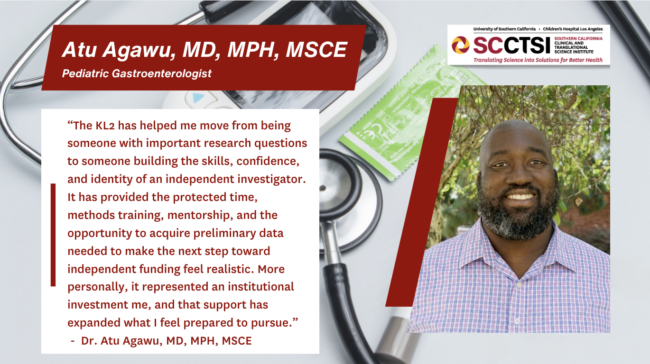
The KL2 has helped me move from being someone with important research questions to someone building the skills, confidence, and identity of an independent investigator. It has provided the protected time, methods training, mentorship, and the opportunity to acquire preliminary data needed to make the next step toward independent funding feel realistic. More personally, it represented an institutional investment me, and that support has expanded what I feel prepared to pursue.