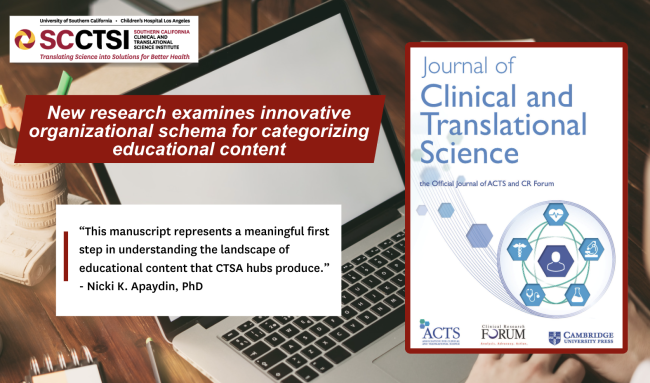
New research examines innovative organizational schema for categorizing educational content
Institutions around the country supported by the Clinical and Translational Science Award (CTSA) awarded by the National Institutes of Health produce an array of educational content aimed at learners across the clinical and translational science continuum. However, there lacks a standard approach in organizing this educational content.
A multidisciplinary team of researchers from the Southern California Clinical and Translational Science Institute (SC CTSI) wanted to establish a method for categorizing content that could be applied across other CTSAs. To dig deeper, they applied a categorization schema to 173 educational videos , which included videos, trainings, seminars, and other content posted on the SC CTSI’s Online Educational Library (OEL). These videos appear on three video platforms: YouTube, Panopto, and Vimeo.
“This manuscript represents a meaningful first step in understanding the landscape of educational content that CTSA hubs produce,” said Nicki Apaydin, PhD, Director of Communications for the SC CTSI and lead author of the manuscript. “We piloted an approach that we hope can be refined and improved upon by other hubs nationwide.”
This schema was originally created by the Joint Task Force (JTF), and outlines the essential skills clinical research professionals need to be effective at their jobs. The JTF is an international group composed of investigators, educators, and clinical research professionals who collaborated on the framework.
The eight competency categories within the framework include:
- Scientific concepts and research design
- Ethical and participant safety considerations
- Investigational products development and regulation
- Clinical study operations (Good Clinical Practice)
- Study and site management
- Data management and informatics
- Leadership and professionalism
- Communications and teamwork
The SC CTSI researchers thought this framework was a useful starting point, but felt that the framework needed tailoring to fully suit the Institute’s educational needs and offerings. They formed a coding group to conduct a content analysis, and adapted the JTF framework accordingly.
They came up with the following competencies:
- Communication, Dissemination, and Teamwork
- Data Management and Informatics
- Leadership and Professionalism
- Regulatory and Quality Sciences
- Research and Study Design
- Study and Site Management
- Ethics and Participant Safety
- Research and Study Conduct
- Other
- Multiple Categories
After collecting data based on the coding and competencies, researchers discovered that YouTube had the highest public reach and shorter videos gained more traction. Users tended to watch newer videos as well. The researchers stated the importance of understanding viewership, and they called for more CTSAs to display educational content on public-facing websites, which they argue would help democratize learning and access.
Ultimately, the researchers from SC CTSI found that adding these categories did not meaningfully change video views over time, but this study was the first of its kind to establish and apply a method of categorization to CTSA-produced educational content. Therefore, they recommended that multiple CTSA hubs collaborate to create a more effective schema for organizing training and educational media across multiple platforms.
To better serve the clinical and translational workforce, CTSA hubs are expanding their development of educational offerings even more toward Translational Science. It would be a worthwhile endeavor to consider effective and tailored ways to categorize educational content to best serve the end users. Doing so will help CTSA hubs improve the impact of their educational videos. As for future research, the group plans to potentially apply new organizational schema to better categorize videos as educational and strategic priorities shift.
Click HERE to read the manuscript.