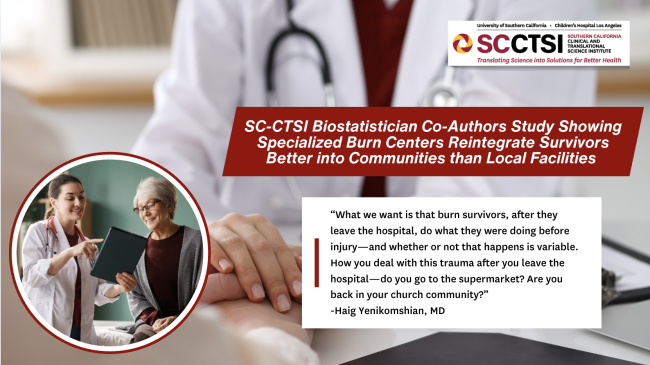
SC-CTSI Biostatistician Co-Authors Study Showing Specialized Burn Centers Reintegrate Survivors Better into Communities than Local Facilities
Many advantages of major burn centers over local rehabilitation facilities disappear after considering patient differences, so researchers call for combined care that merges burn-center expertise with local services.
Burn survivors who continue rehabilitation at specialized burn centers return more fully to community life than those who continued their rehab at other facilities, according to a new study. However, most of the benefits of burn-center care were not evident once researchers accounted for patient differences, and any physical or occupational therapy was shown to improve burn recovery.
Once differences between patient populations is factored in, the therapy in burn centers and local facilities is virtually equivalent. However, burn centers better integrate patients into daily life. The findings point to a need for integrated care models that pair the specialized resources of burn centers with the convenience of local facilities, the researchers noted.
The study, published in the Journal of Burn Care & Research, was led by Haig Yenikomshian, MD, Associate Professor of Clinical Surgery at the Keck School of Medicine of the University of Southern California. Researchers analyzed data from 1,520 adult burn survivors treated between 2016 and 2024, drawing on the Burn Model System National Database, a multicenter registry tracking patients across four burn centers in multiple states.
Trevor Pickering, PhD, Associate Professor of Clinical Population and Public Health Sciences at the Keck School and Co-Director of Southern California Clinical and Translational Science Institute (SC CTSI) Biostatistics, co-authored the study and led the statistical analysis.
“I’ve been working with Trevor on multiple projects over six or seven years now,” said Yenikomshian. “I will show him my research question and say, ‘this is what I want to answer,’ and then he’ll help me determine how to answer that.”
Initial comparisons suggested burn-center care led to better physical function and social outcomes than treatment in outside facilities. But once researchers adjusted for factors such as age and insurance type, those advantages largely disappeared, with one exception. Care at a burn center remained significantly associated with stronger “community integration,” a measure of how well patients return to routines such as grocery shopping, socializing with friends, or participating in religious and community activities.
Researchers tracked outcomes using validated patient-reported measures at 6, 12, and 24 months after discharge. They also identified common barriers to continued therapy, including cost, transportation difficulties, and a perceived plateau in recovery. These factors often led patients to choose options that were more easily accessible to them as they gained independence.
Pickering’s biostatistics team provided data management and analysis services for the project. The team used statistical analysis of results that helped them understand relationships between rehabilitation settings and recovery outcomes while controlling for demographic differences. The researchers analyzed complex, multi faceted data and adjusted for patient differences, estimating associations between therapy location and recovery. But this observational study could not determine causal relationships.
“Any rehab is better than no rehab for burn survivors, but treatment in a specialized burn center offers a clear edge in helping patients return to their normal lives,” Yenikomshian said.
The researchers set out to learn who accesses outpatient rehabilitation, where they receive it, and how those choices shape long-term outcomes. Moreover, many patients start at specialized centers before shifting to outside facilities, primarily due to cost.
Burn centers have specialized clinical experience and established partnerships with outside organizations. Those connections, he said, let burn centers link survivors with peer-support networks.
“We have partnerships with foundations, and we work with the wellness center at the Los Angeles General Hospital, so we have community programs for patients,” Yenikomshian said. “If you're having difficulty processing your trauma of burn injury, you can talk to another burn survivor who's gone through what you're going through,” he added. Burn injury is life changing for anyone, but connecting with other survivors is powerful and can help with recovery.
“What we want is that burn survivors, after they leave the hospital, do what they were doing before injury—and whether or not that happens is variable,” Yenikomshian said. “How you deal with this trauma after you leave the hospital—do you go to the supermarket? Are you back in your church community?”
“This research is part of a larger effort to improve burn recovery by analyzing existing data and by collecting data from patients that members of the team have seen in burn recovery,” said Pickering.
The researchers called for continued research and policy attention to improve access to and effectiveness of rehabilitation services for burn survivors nationwide.