LA Hospital Violence Programs Promising Despite Major Challenges, SC CTSI-funded Study Shows
SC CTSI-funded study finds hospital violence intervention programs effectively engage survivors but struggle for a variety of reasons.
Hospital programs designed to prevent repeat victims of violence have shown success but face significant funding and coordination problems that limit their ability to help them, according to a new study of Los Angeles County’s intervention network. The study was supported by the Southern California Clinical and Translational Science Institute (SC CTSI).
“Hospital-based violence intervention has a lot of benefits, but it’s often orphaned between healthcare and social services,” said Todd Schneberk, MD, MS, MA, principal investigator and Assistant Professor of Clinical Emergency Medicine at the Keck School of Medicine at the University of Southern California (USC). “In times of fiscal austerity, these are exactly the kinds of programs that get cut—even though we know they work and bring real benefits to our patients and communities.”
Researchers interviewed 16 program staff, administrators and medical providers across three hospitals to evaluate barriers facing the Los Angeles County Hospital Violence Intervention Program. The findings, published in the Journal of Urban Health, reveal a system hamstrung by inadequate resources despite strong patient engagement.
Violent injury is among the top five causes of death for people ages 5 to 35 in the U.S. Between 29% and 37% of violence victims suffer reinjury, often requiring repeated emergency care or resulting in death.
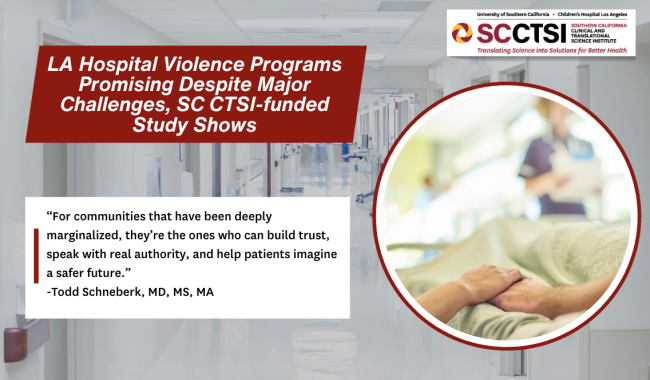
Hospital-based violence intervention programs attempt to break this cycle by connecting patients with community health workers during or after hospitalization. These workers, often violence survivors themselves, provide case management, mentorship and help securing housing, job training, mental health treatment and other services.
“When we target our patients, they see us in the same situation that they’re in at the moment,” said one community health worker interviewed for the study. “And a lot of times that carries a little bit more weight.”
But funding constraints create severe staffing shortages. Some sites reported just four or five case managers for more than 700 eligible patients. Poor coordination between hospitals and community organizations emerged as another major obstacle, with hospital staff frequently unaware that the programs existed, hampering referrals. Community health workers also struggled to access hospital electronic medical records and lengthy credentialing processes which sometimes left positions unfilled for extended periods.
Unstable funding drives high staff turnover. Programs must release trained workers during budget cuts, then spend resources training replacements when funding returns. The study found workers sometimes used personal money to help patients, revealing funding gaps and raising burnout concerns.
Despite these obstacles, stakeholders said the programs effectively engage violence survivors. Clinical trials of similar programs show participants have significantly less prison time than control groups. However, patients often wait months for housing, mental health services, and other critical resources. These delays outside program control can cause some to drop out.
Researchers estimate mid-sized cities need about $10,800 per participant, meaning millions annually for large urban areas serving thousands of violence victims. Only one program in the study—funded directly by its hospital rather than by grants—reported stable operations. Grant-dependent programs faced significant disruption.
The study interviewed four community health workers, four community organization administrators, four medical providers, and four executives between February 2023 and November 2024, achieving an 84% response rate. At least two researchers independently reviewed each interview transcript to identify key themes, discussing any differences until they reached agreement.
The study recommends shared funding between hospitals and community organizations, coordinated staff training, standardized workflows with integrated technology, and the placement of violence intervention workers directly within hospital teams.
“The people doing this work come from the same neighborhoods and have lived through similar violence,” Schneberk said. “For communities that have been deeply marginalized, they’re the ones who can build trust, speak with real authority, and help patients imagine a safer future.”
The program partners with community organizations like Soledad Enrichment Action, whose staff have lived through similar experiences and know local neighborhoods and gang dynamics. They offer two levels of support: from basic resource connections; and an intensive six-month program with peer mentors, case managers, mental health care, housing and financial assistance, and help with education and employment.
Schneberk is a past awardee of the Health Systems Innovation Award for this effort. SC CTSI and Children’s Hospital Los Angeles provide funding, training and other research resources for awardees.
“The Health Systems Innovation Award backs team-based projects that take proven ideas beyond clinical trials and scale them across real-world health systems,” said Allison Orechwa, PhD, MBA, SC CTSI Executive Director. “The hope is that this program can reach all patients who need support after violent injury.”
“We already spend enormous sums on repeated trauma admissions and incarceration,” Schneberk added. “Investing in prevention isn't just humane—it’s cost-effective, and it helps people become healthier, more productive members of their communities.”