Institute Overview
The Southern California Clinical and Translational Science Institute (SC CTSI) is a partnership between the University of Southern California and Children’s Hospital Los Angeles. Our mission is to translate science into solutions for better health.
Operating in one of the nation's most complex urban environments, the SC CTSI is tackling the "last mile" of translation, where innovation meets implementation. We aim to ensure that proven scientific discoveries don't stay trapped in academic journals, but are put to work in real-world settings like healthcare systems and local neighborhoods. To overcome obstacles like fragmented care and varying levels of community trust, we partner directly with three health systems and over 150 local community organizations, including schools, faith-based groups, and healthcare providers.
These collaborators help shape our research priorities, support public health emergency responses, and ensure that our solutions fit the actual needs of the people in Southern California. We also collaborate with research hubs across the country as part of the national Clinical and Translational Science Awards (CTSA) network.
We take two approaches to move scientific discoveries into clinical testing and then into healthcare and community health settings: We support a wide range of Translational Research at USC and CHLA through comprehensive, easily accessible services and education; and we use that experience to identify common challenges to the translational process and solve them through Translational Science.
Translational Research & Translational Science Explained
Translational Research
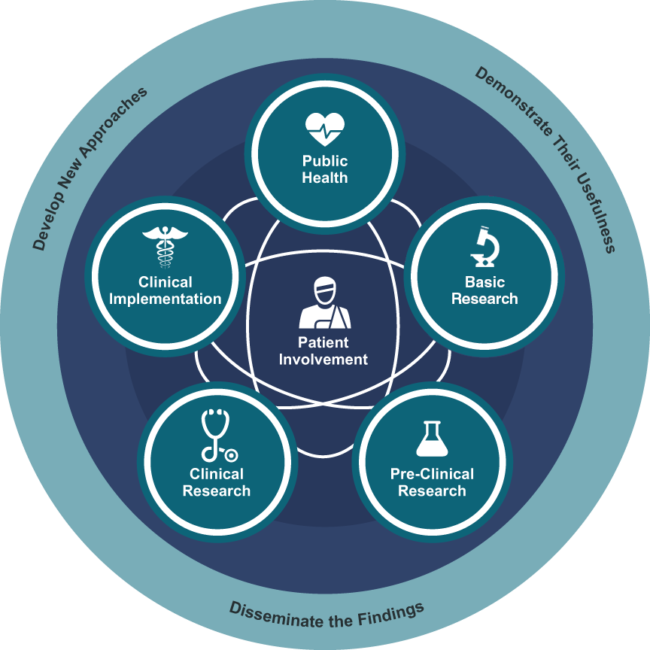
The translational spectrum captures the complicated relationship between scientific discoveries and everyday care that improves human health. Basic research uncovers how biology and disease work. Pre-clinical testing in labs explores potential treatments. Clinical research examines the safety and effectiveness of new treatments or diagnostic approaches in patients. Once proven in a research setting, these new approaches are tested in real world settings like clinics and communities. Ultimately, public health research measures their impact across broader communities. The process is often non-linear, with each stage informing others as knowledge makes its way to clinical care and better health.
The SC CTSI offers expert consultations and other resources to support human-focused translational research from the pre-clinical stage to public health research. Find Research Resources.
Translational Science
Through Translational Science, the SC CTSI addresses challenges in the translational research process, using a three-stage approach: a) identifying and characterizing the challenge, b) developing and testing new strategies to overcome the challenge, and c) implementing and disseminating proven strategies to improve the research process in a novel way. Our work creates solutions that accelerate progress across many disease areas.
We invest in Translational Science through internal pilot grants, career development awards, and internal demonstration projects.
Our Approach to Translational Science
We approach Translational Science through observation and intervention. Observational Translational Science involves systematic examination of the translational research process from inception through dissemination, revealing common barriers and opportunities for improvement. We ask our stakeholders for input on issues affecting the efficiency, quality, and impact of research. Using this information, we apply Interventional Translational Science to develop and test new solutions to enhance the efficiency, quality and impact of translational research, from start-up to dissemination and implementation.
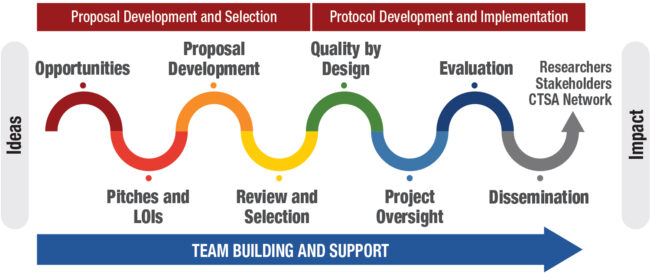
We employ a rigorous, two-stage framework - Moving Ideas to Impact, or MITI (pronounced “mighty”) - to develop and support Translational Science projects. In the initial stage, ideas are developed into full proposals that compete for SC CTSI resources. In the second stage, selected projects are implemented using quality assurance and project management principles. SC CTSI provides team building and wrap-around support throughout the MITI process and supports dissemination and implementation of successful solutions.
Current Priorities and Projects
Our Strategic Priorities reflect the interests and needs of both CTSI researchers and external stakeholders.
Translational Research Highlights
- Interview with Dr. Atu Agawu, MD, MPH, MSCE, KL2 award… | SC CTSI
- SC CTSI biostatistician helps researchers rethink tendon… | SC CTSI
- SC CTSI-supported Study Shows Children’s Health Can Improve… | SC CTSI
- New manuscript shows how essential promotoras are for… | SC CTSI
Translational Science Highlights
- Quality by Design: Based on a popular quality management framework, the SC CTSI Quality by Design program helps researchers mitigate risks to successful study completion through Design Studios, team science, and project management support. A current long-term translational science project is evaluating the implementation and impact of the program on our funded studies, which vary in discipline and study design.
- Trial Tracker: This new SC CTSI tool provides real-time tracking of enrollment vs. target for clinical studies. The current translational science project is testing whether regular reporting of enrollment to research teams increases enrollment compared to simple access to the tool.
- Hollywood, Health and Society (HH&S): HH&S is an established USC resource that helps the television industry depict medical themes accurately. SC CTSI partners with HH&S to get clinical research themes on television. A current translational science project is evaluating the impact of televised clinical trials themes on the public’s trust and interest in clinical trials.
- Recruitment Studios: This service provides hands-on, intensive support for studies seeking participants for clinical studies. Recruitment strategies include cohort discovery via electronic health records, direct messaging via patient portals, social media outreach, and engagement of patient organizations. A current translational science project is assessing the impact of Recruitment Studios on recruitment rates compared to standard practice.
- Federated Learning: Federated learning enables secure, private, distributed mega-analysis without direct sharing of data. A current translational research project is assessing the utility of federated learning in a study to identify drivers of the length of mechanical ventilation in adult and pediatric critical care patients across USC and CHLA.
People
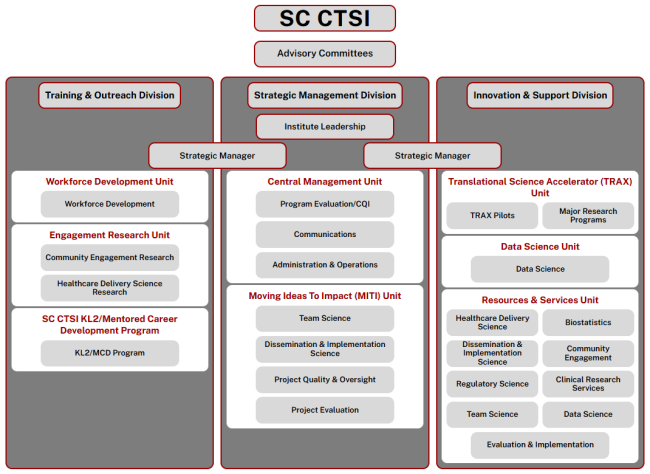
The heart of the SC CTSI is its people, who provide expertise and support across an incredible range of translational research and science. They are organized into three major divisions that work in sync to transform discoveries into real-world impact with efficiency and quality.
Click the image below to view our organizational chart and find out more about the people and teams that make up SC CTSI: