Access census-tract data to power research on social and environmental determinants of health
Goal:
Access Databases and Cohort Discovery
Phase:
Planning & Design
Service description
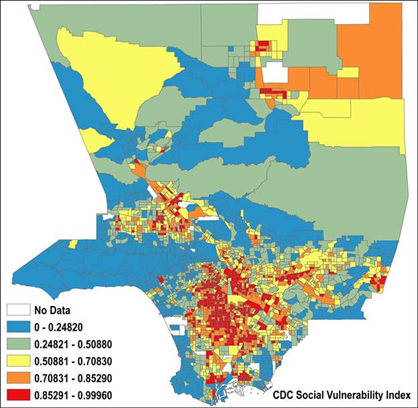
In collaboration with the Spatial Sciences Institute at USC, the SC CTSI provides services for investigators with an interest in linking geospatial and patient health data. We help researchers access census-tract-level data such as exposure to environmental risk factors (e.g., air and water quality metrics), socio-economic and environmental conditions (e.g., median income, education, access to food), and neighborhood demographics (e.g., population density, race, ethnicity). Incorporated into research datasets, these data can power research on social and environmental determinants of health without the need to disclose patient addresses. SC-CTSI/CRI and ISI staff can consult with teams interested in these data in their research, to understand the nuance of these variables in context.
42 social and environmental measurements from 6 different data sources (e.g., CDC, Cal EPA, ACS/US Census Bureau) are available, including:
Researchers can also obtain patient-level social and environmental health data by submitting a request to our CRI Service Hub.
Click here to view the FAQs for research data requests, tools, and other informatics services.
Cost
An initial one-hour free consultation is provided to assess project needs, identify appropriate services, and determine the number of hours or level of effort required for the project. Any additional consultation time will be provided on a recharge basis. Investigators may qualify for free consultation hours through one or more categories; however, the maximum number of free consultation hours available per investigator across all projects per fiscal year is 9, including initial consultation hours. Following the initial consultation, investigators will receive a recommended scope of work and cost estimate.