Awarding Standardized Digital Badges Aims to Elevate Team Science Professionals
Digital badges serve as micro-credentials that certify a Team Science Professional’s expertise and level within the field.
Multidisciplinary collaboration and successful team science are integral to solving complex health problems. The people who work in this field, referred to as Team Science Professionals (TSPs), act as facilitators for team dynamics and collaborative strategies. They can also serve as educators on the process of building and sustaining high-performing teams. However, a lack of standardized training and career paths for TSPs means that their roles can be underdeveloped and undervalued.
To address this issue, a group of researchers within the Association for Clinical and Translational Science (ACTS) came together to propose strategies for professionalizing the field, including the creation of a digital badging system. They published their work as a perspective article in Frontiers, and in true team science fashion, the authors represent 12 Clinical and Translational Science Awardee (CTSA) Hubs. CTSA Hubs are centers affiliated with universities across the nation, and are funded by an award from the National Center for Advancing Translational Sciences.
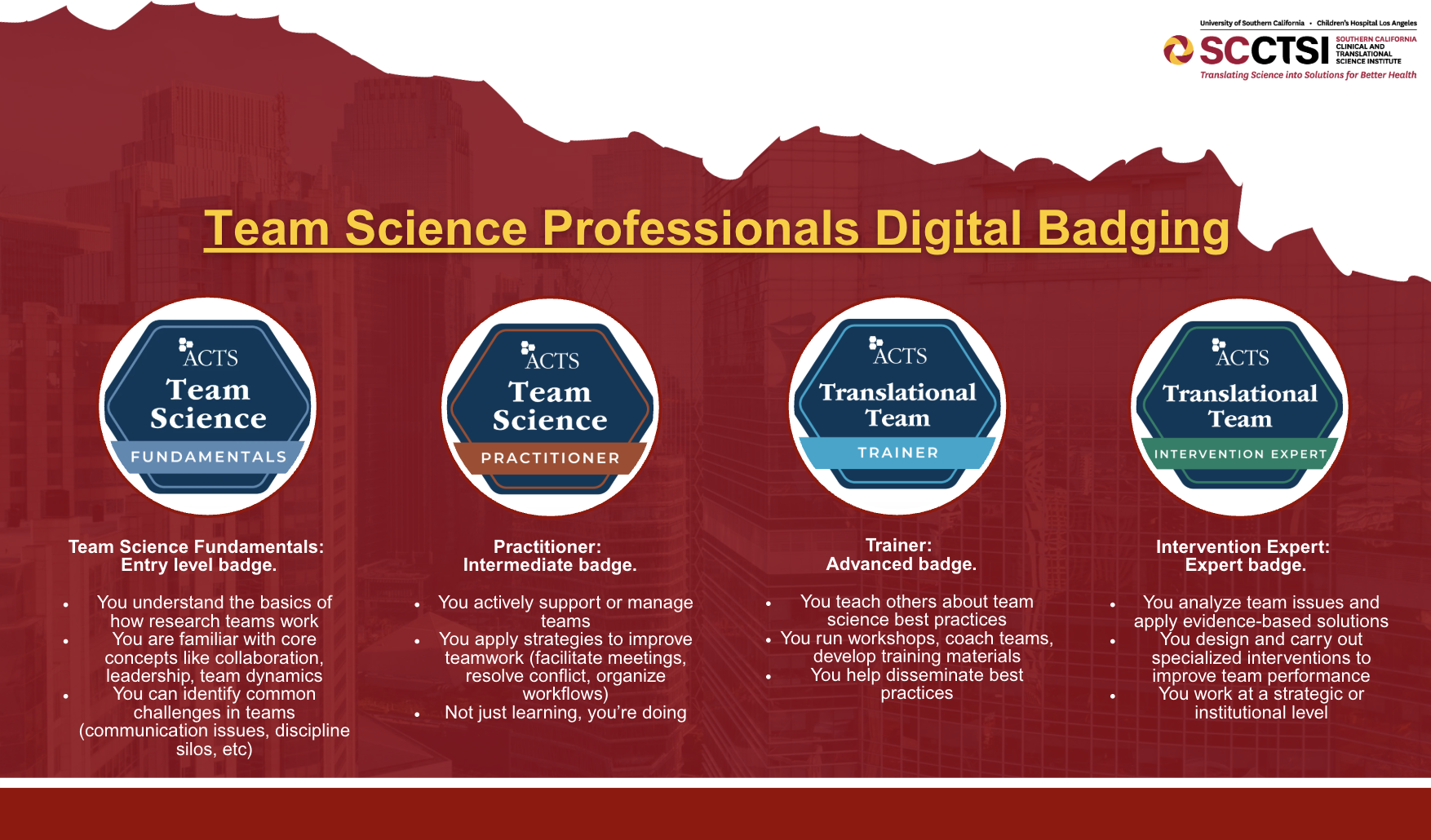
In their manuscript, they explain the value of digital badging. These badges serve as micro-credentials that certify specific competencies and levels within team science. The levels include Team Science Fundamentals, Practitioner, Trainer, and Intervention Expert. Explanations of these levels are below. Currently, you can access the first two badges here.
“I am interested in this work selfishly because I am a TSP. As the evaluation co-lead, these efforts are sparking useful discussions around what does it mean to be a TSP, what do we want the future of TSPs to look like, and how do we know when we get there?,” said Mayla Boguslav, PhD, Director of Team Science and Research Associate at the Southern California Clinical and Translational Science Institute (SC CTSI).
The pathway for earning these badges involves completing specific training activities across multiple platforms and submitting proof of completion. Badges are awarded digitally and are stackable, and learners are able to display them on their professional social media sites such as LinkedIn or in their email signatures
This group will continue to meet as it is an ongoing Special Interest Group within the ACTS, the premier professional organization supporting the needs of the CTSA hubs across the country. The group will continue to work on the last two badges, adding more training options for individuals affiliated with CTSAs and beyond. They will also evaluate their work and write a manuscript with the data they have collected on the digital badging efforts. Currently, they are working on a landscape assessment to understand how institutions support TSPs and team science.