Community Health Workers Graduate from USC-CHLA Certification Program
A six-week hybrid program trained 21 community health workers to address chronic disease, promote health, and connect residents to care across Southern California.
In July 2025, 21 community health workers (CHWs) completed the pilot of the Community Health Worker Certification Program, an initiative developed by the USC Office of Health Affairs and Children’s Hospital Los Angeles. The program was created to strengthen the CHW workforce in Southern California by equipping participants with the skills and knowledge needed to address chronic disease, promote health, and connect community members to care.
The six-week program was led by a facilitation team that included community outreach coordinators from the Community Engagement Core at the Southern California Clinical and Translational Science Institute (SC CTSI), along with additional staff who supported instruction and coordination. The team managed logistics, provided bilingual materials, conducted structured check-ins, and offered ongoing guidance throughout the course. Sessions were designed to be hands-on and interactive, creating a learning experience that was both rigorous and supportive.
“Community health workers are essential to building trust and improving health outcomes,” explained Nicole Wolfe, PhD, Co-Director of the Community Engagement Core. “Professional development programs like this one invest in CHWs as individuals and also strengthen the entire public health system by equipping them with the tools and confidence to lead change from within their communities.”
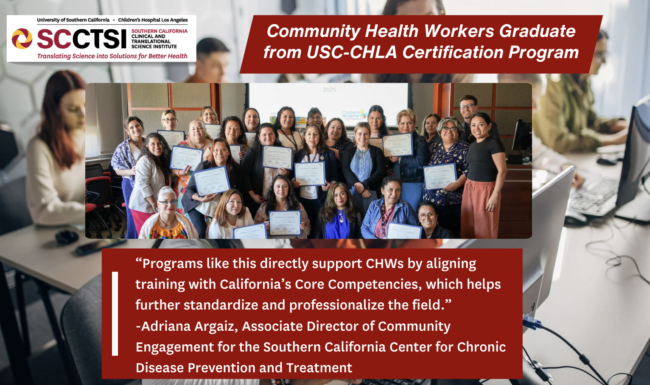
Developed with direct input from active CHWs, local health organizations, public health experts, and local organizations, the curriculum emphasized practical tools and leadership development. It was guided by the C3 National Consensus Project on CHW roles and competencies and aligned with California’s Core Competencies for CHWs to support future certification. Special attention was given to ensuring the content was grounded in real-world challenges and community experiences.
“Programs like this directly support CHWs by aligning training with California’s Core Competencies, which helps further standardize and professionalize the field,” noted Adriana Argaiz, Associate Director of Community Engagement for the Southern California Center for Latino Health. “This training ensures that CHWs are prepared to meet the needs of their communities and be recognized as skilled professionals within the broader healthcare workforce.”
The program followed a hybrid format, beginning with an in-person orientation and concluding with a final session that included a feedback discussion, project presentations, and a certificate ceremony. Over six weekly modules, participants engaged with asynchronous video lessons, written reflections, hands-on assignments, and live Zoom sessions. Topics included understanding behavior change, communication strategies, professional development, leadership, research literacy, and outreach techniques.
Each participant completed a project presentation focused on a health issue in their community. Using newly-acquired CHW tools, they conducted an assessment and developed an outreach plan in response. Presentations included a fact sheet, a PowerPoint deck, and a brief talk with visual aids–demonstrating their ability to communicate clearly, engage communities, and create solutions that reflect the values and needs of the populations they serve.
“Each module and its reflections were very important in shaping our understanding and responsibilities,” one of the program graduates remarked. “The activities during each Zoom meeting were a challenge for me, but they helped me grow. Collaborating with others and participating as part of a team gave me valuable experience and taught me things I never imagined I would learn, including how to create and deliver a presentation.”
Another graduate described how she immediately began putting what she learned into practice. “I didn’t wait until the end to apply what I was learning. With each module, I started using it at work, helping my colleagues and conducting surveys,” she said.
The Community Engagement Core is currently reviewing participant feedback and program outcomes to inform next steps. Plans are underway to launch a second cohort in early 2026. The Community Health Worker Certification Program reflects a broader commitment to developing a well-prepared, community-rooted public health workforce. As this new cohort of CHWs returns to their communities, they carry the tools to make a lasting impact.