Former KL2 awardees expose disparities in access to life-altering brain treatment
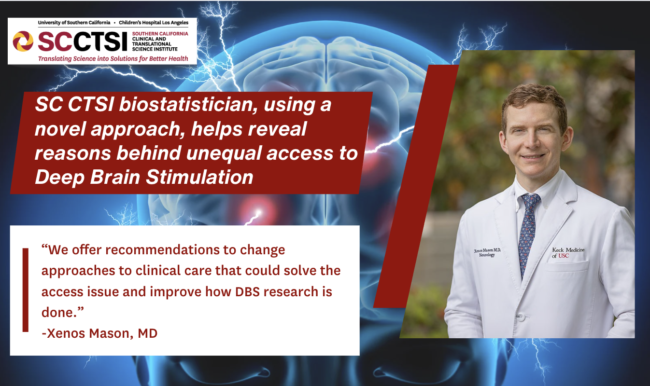
Using a novel approach, an SC CTSI biostatistician helps reveal reasons behind unequal access to Deep Brain Stimulation.
Deep Brain Stimulation (DBS) is a surgical treatment used for movement disorders such as Parkinson’s disease. DBS involves making small holes in the skull and implanting electrodes into deep but small brain structures. High-frequency electrical fast pulses are sent to these brain areas, improving movement.
This effective treatment has been available since 1996, but not everyone who could benefit has the same opportunity. Significantly improving DBS access is possible but would require coordinated efforts among researchers and the healthcare system.
A scoping review and qualitative analysis published in Movement Disorders Clinical Practice investigates who is, and is not, receiving DBS and explores the reasons why. The review examined 46 studies across multiple countries, synthesizing an understanding of worldwide disparities in DBS treatment availability.
“We offer recommendations to change approaches to clinical care that could solve the access issue and improve how DBS research is done,” said Xenos Mason, MD, Assistant Professor of Clinical Neurological Surgery and Neurology at the Keck School of Medicine of the University of Southern California (USC), and first author of the review.
The review found that individuals from certain racial and ethnic groups, as well as women and other populations, are significantly less likely to receive DBS. Geography and income matter as well. People with private insurance or who live in wealthier areas or regions near specialty medical centers are likelier to receive DBS treatment than those on Medicaid or in lower-income neighborhoods. These barriers to access are complex interconnected systems rather than simple isolated challenges. Barriers include miscommunication between clinicians and patients, inflexible referral networks, and outdated policies by government and health care systems.
The authors used a novel approach known as grounded theory to analyze existing literature and uncover foundational principles contributing to inequities, mapping how many different factors can interact.
Rachel Ceasar, PhD, a qualitative research consultant with the Biostatistics Epidemiology and Research Design (BERD) team at SC CTSI and an Assistant Professor of Clinical Population and Public Health Sciences at USC and the qualitative research consultant with SC CTSI BERD, was instrumental from the early stages of study design. She provided qualitative research support in conducting analysis and paper writing.
“Xenos and his team set out to use grounded theory for their literature review—not an easy method—as a way to capture new insights, or theories, around deep brain stimulation disparities,” Ceasar said.
The authors noted that researchers and clinicians have not paid enough attention to how social and cultural factors influence healthcare in general and how personal biases can influence how they interpret study data. These dynamics must be understood to develop more comprehensive, targeted solutions for improving DBS access. Solutions include better communication between providers and patients, policy overhauls, and improved ways to identify and refer patients.
The research team also calls for further clinical training for healthcare professionals to help more patients gain access.
“Providers need to feel confident describing DBS to a patient who could be a good candidate for it, thoughtfully addressing questions that may come up in exploring a referral,” said Mason. “Smaller hospitals and more community centers are starting to offer it because more community neurosurgeons are getting the training necessary to implant these devices.”
The review’s findings could help improve DBS access to psychiatric treatments, according to Adam Frank, MD, PhD, a co-author and Assistant Professor of Clinical Psychiatry and the Behavioral Sciences at the Keck School of Medicine of USC.
“The use of DBS, particularly in the domain of psychiatry, is likely to expand over the coming years, and this review is important in highlighting that we want to be thoughtful and considerate to improve access to a treatment that can be very effective for certain patients,” said Frank.
The study was initiated when Mason and Frank participated in the three-year KL2 Mentored Career Development award, supported by SC CTSI.
“One of the projects in the coursework required for the KL2 is developing a protocol for a scoping review, and Dr. Mason and I worked as a team,” Frank added. “With a few other KL2 scholars, we wrote the protocol, which was published, and after the program, we decided we should complete the review itself. The coursework and structure of KL2 brought us together to work on this while otherwise, we might not have met. The financial support from the KL2 allowed us the time to conduct these studies.”