Interview with Dr. Caitlin Sayegh, PhD, KL2 award recipient
An interview with a recipient of the SC CTSI Mentored Career Development in Clinical and Translational Science award
Tell us a little bit about your experience in the KL2 program.
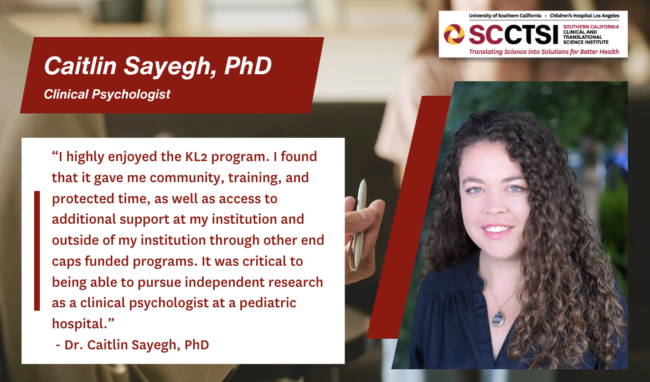
I highly enjoyed the KL2 program. I found that it gave me community, training, and protected time, as well as access to additional support at my institution and outside of my institution through other NCATS programs. It was critical to being able to pursue independent research as a clinical psychologist at a pediatric hospital.
What do you think others can gain from this program?
As somebody who did have research training prior, I really appreciated that it professionalized me as a researcher. I think for people with less research experience and more clinical experience, it would offer so much in terms of basics and fundamentals of research, but even for somebody with significant research training, the program helped launch me into being more effective and leading research teams.
Tell us about your own background as a researcher and clinical psychologist.
My initial motivation was to train in effective positive youth development frameworks and that brought me to clinical psychology. I learned to love research, especially working with vulnerable youth such as those involved with the children's courts and those with medical conditions. I feel very fulfilled and effective being both a clinician and the researcher, because I can intervene directly to support youth and families, I can train the next generation of researchers and clinicians, and I can discover new ways of understanding how to best help youth and then disseminate those strategies through my research. My background was first looking at concepts like family systems, motivation, and pilot randomized controlled trials. Since coming to Children's Hospital Los Angeles and USC Keck School of Medicine, I've been building my community engagement skills, mixed methods research skills, and developing a line of research focused on digital health interventions for youth with chronic illness.
What drove you to specialize in this?
I was always called to be a helper and especially interested in supporting adolescents because I think that it's a critical period when you're still embedded in a lot of structures and systems of care from families to schools to youth programs to hospitals. I also just enjoy connecting with teenagers because they're very creative, and have so much potential. Clinical psychology gave me a scientific set of tools to understand what goes wrong in adolescent development and what can help. I've always looked to join teams that are rooted in compassion, whether that was working with psychologists focused on gang affiliated youth, social workers and nurses working with youth in foster care, or at my current institution within interdisciplinary teams working with adolescents growing up with chronic medical conditions.
Looking at your work on Adaptive Cell Phone Support (CPS), what impact do you feel you’ve already been able to make on how adolescents with chronic conditions are supported in real-world care settings?
It's very exciting to conduct research that actually delivers a promising intervention to participants in the studies. I've really appreciated getting to work in clinical and translational science because I'm getting a front row seat to how our ideas can immediately help and impact youth. The way that we've been building our intervention (Adaptive Cell Phone Support) is with human centered design and iteratively improving the intervention across multiple cohorts. I believe the intervention continues to grow stronger, but even in its earliest draft we saw clear signs of its positive impact. Within just a few weeks, we observed improvements in youths’ medication adherence, and their qualitative feedback highlighted how meaningful it was to have consistent support and care as they navigated the challenges of growing up with a chronic health condition. Even beyond the effects of the intervention on their sense of well-being, their medication adherence, and ultimately their health status and readiness to transition to adult systems, I've seen an impact on the youth participants being part of the research process and being able to give their feedback to make an impact on patients growing up younger than the. They join our studies with a sense of altruism, and are trying to help those next generations of patients have a better time and receive more helpful support. Since the KL2 until today, I've been working with the same Youth Advisory Board that's been guiding my research and I've seen a few of them already grow up and become educators and clinicians themselves and coauthor papers and speak on panels. This has clearly been an impactful experience for them and I appreciate the impact they've made on our science.
What has been the most rewarding part of being a part of the KL2 program?
It's hard to name one thing and I think there are so many tangible parts that were clearly rewarding. To add something beyond what I've shared in the previous questions, I would say getting that external stamp of approval gave me confidence that my research ideas were good and that my skill set and work ethic were recognized. That helped me stay the course on developing a research career.
What does the KL2 program mean to you, and how has it furthered your career?
The KL2 program was a pathway for me to develop a lab (the Design with Adolescents and Young Adults for Self-Management and Health Lab: https://www.chla.org/research/lab/dash) that I could lead and secure extramural funding to support my own research questions. It helped me join a cadre of early career smart and hard-working folks. Also, it strengthened my commitment to clinical and translational science, rather than going into extremely detailed intricate linguistic understanding of therapy change processes. I was at a pathway of trying to really focus my research on tinkering under the hood of therapy (which is still of interest to me), but I was persuaded and compelled to work on projects that had more clear patient impact. This fits my moral compass and it also fits my workplace as a researcher in a pediatric hospital. Very applied and translatable studies make the most sense.