Meet Xzania White Lee, KL2 Pathways Scholar at CHLA
We sat down with Dr. Xzania White Lee, a KL2 Pathways Scholar at CHLA, to hear about her experience and how she has furthered her professional goals. We look forward to seeing all she will accomplish in the coming years.
Tell us a little bit about your experience so far in the KL2 Pathways program.
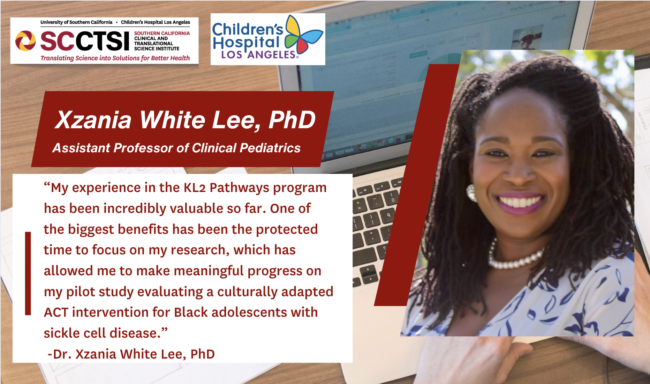
My experience in the KL2 Pathways program has been incredibly valuable so far. One of the biggest benefits has been the protected time to focus on my research, which has allowed me to make meaningful progress on my pilot study evaluating a culturally adapted ACT intervention for Black adolescents with sickle cell disease. The structured mentorship has also been a major asset—I’ve received thoughtful guidance from experienced researchers, which has helped me refine my study aims, strengthen my methodology, and think more strategically about my long-term research goals. Overall, the KL2 program has provided both the space and support I need to grow as an independent investigator committed to advancing health equity.
How did you first learn about the program?
I first learned about the KL2 Pathways program through Dr. Caitlin Sayegh, a colleague and previous awardee. She played a key role in mentoring me at the early stages of my project and was instrumental in helping me prepare a strong application. Her experience and encouragement were critical in introducing me to the program and guiding me through the process.
What initially got you interested in starting this program? What initially drew me to the KL2 Pathways program was the opportunity to receive dedicated research time, structured mentorship, and targeted training to support my development as an independent investigator. I was particularly interested in how the program could help me strengthen the foundation of my pilot study focused on culturally adapted mental health interventions for Black adolescents with sickle cell disease. The chance to be part of a supportive research community while advancing work that directly impacts marginalized populations made the program feel like a perfect fit for my goals.
Tell us about your own background as a researcher in your research area.
My background as a researcher is rooted in my clinical work as a licensed psychologist, where I specialize in providing mental health care to adolescents and young adults, particularly those from historically marginalized communities. My research focuses on culturally responsive, evidence-based interventions that address the unique mental health needs of Black youth, especially those living with chronic illnesses like sickle cell disease. I’m especially interested in how race-related stress, stigma, and systemic barriers to care impact psychological outcomes. My work combines community partnerships, clinical insight, and culturally adapted models like Acceptance and Commitment Therapy (ACT) to improve mental health access, engagement, and outcomes for BIPOC adolescents.
What drove you to specialize in this field?
What drove me to specialize in this area was a personal understanding of the need for representation in both mental health research and clinical practice. As a teenager, I saw firsthand how few providers and researchers looked like me or understood the cultural context of the mental health challenges faced by Black youth. That lack of representation contributed to mistrust and gaps in care. I was motivated to be part of the solution—to create culturally responsive interventions and help close the disparities in mental health access, treatment, and outcomes for marginalized communities.
What do you think that others can gain from this program?
Others can gain a great deal from the KL2 Pathways program, including dedicated time to focus on their research, access to experienced and supportive mentorship, and opportunities for interdisciplinary collaboration. The program also provides valuable training in research design, grant writing, and career development—tools that are essential for building a strong foundation as an independent investigator. Just as importantly, it offers a sense of community and support that can be incredibly motivating and grounding, especially for early-career researchers working to make an impact in their fields.
Have you run into any challenges or obstacles along the way?
Yes, one of the initial challenges I faced was reducing my clinical caseload to make room for my protected research time. That transition took about two months, which delayed the start of some of my research activities. Balancing clinical responsibilities with research commitments is always a challenge, but once the adjustment was in place, I was able to fully engage with the KL2 program and make meaningful progress on my project.
What has been the most rewarding part of being a part of the KL2 Pathways program?
The most rewarding part of being in the KL2 Pathways program has been working alongside scientists who are true allies—people who are genuinely committed to mentoring me and supporting my mission to close the mental health gap for Black youth. It’s been incredibly affirming to be part of a community that not only values my research focus but actively helps me grow as a leader in this space. That level of support and shared purpose has made a huge impact on both my professional development and personal motivation.
What does the program mean to you and how has it furthered your career?
The KL2 Pathways program has been instrumental in advancing my research career, providing protected time, expert mentorship, and valuable training. This support enabled me to become a competitive candidate for the PRIDE-FTG program, sponsored by the NHLBI. PRIDE-FTG is an all-expense-paid summer institute, for scientists from marginalized groups, designed to enhance basic and clinical/translational research skills using functional and translational genomics techniques. The program aims to train junior faculty to conduct research related to blood disorders, such as sickle cell disease, by providing hands-on lab experiences, grantsmanship training, and opportunities for pilot funding.
Who else has been an integral part of your success in this program?
Mentors have played a crucial role in my success within the KL2 Pathways program. In particular, Drs. Jeff Gold, Anya Griffin, Thomas Coates, and my division chief, Claudia Borzutzky, have provided invaluable guidance, support, and encouragement throughout my journey. Their expertise and mentorship have helped me navigate challenges, refine my research, and grow as an independent investigator.