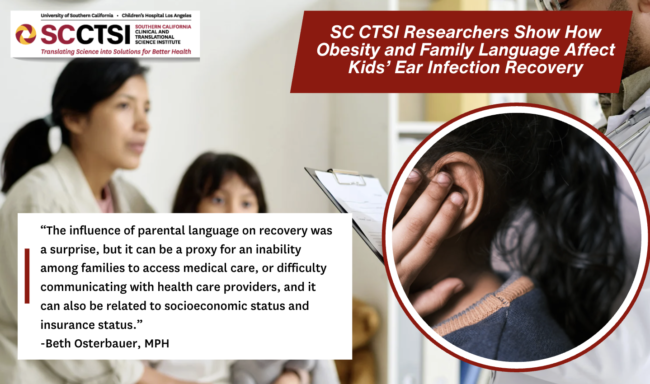
SC CTSI Researchers Show How Obesity and Family Language Affect Kids’ Ear Infection Recovery
An SC CTSI biostatistician helped the research team identify complex treatment factors.
Some providers have been concerned that overweight children seem to take longer to get well from infections. Now, a study has identified two contextual factors—obesity and parental language preference—that can affect longer pediatric recovery times from otitis externa (OE), the common ear-canal infection known as swimmer’s ear, according to a retrospective review of clinical records published in the International Journal of Pediatric Otorhinolaryngology.
“The influence of parental language on recovery was a surprise, but it can be a proxy for an inability among families to access medical care, or difficulty communicating with health care providers, and it can also be related to socioeconomic status and insurance status,” said first author Beth Osterbauer, MPH, Clinical Research Coordinator at Children’s Hospital Los Angeles (CHLA). The review was supported by the Southern California Clinical and Translational Science Institute (SC CTSI).
Results from this first investigation of the effects of obesity and sociodemographic factors on OE infections in children in the United States suggest practical guidance for clinicians and researchers, Osterbauer noted.
Ninety-three children diagnosed with OE between April 2015 and February 2024 at CHLA were included in the review. The team deployed REDCap, a web-based records database and statistical tools, to measure the duration of infections and determine which factors were associated with slower recovery.
About one in three of the children was overweight or obese. Most of the overweight or obese children were Hispanic, spoke Spanish at home and had public health insurance. Non-obese children whose parents primarily spoke Spanish took the longest to recover. The second longest to recover were obese children with English speaking parents. The third longest to recover were obese children with Spanish speaking parents. Non-obese children with English speaking parents had the shortest time to recover from infection.
The review originated from clinical observation by lead author Mary Roz Timbang, MD, Assistant Professor of Clinical Surgery, Keck School of Medicine of USC, that her overweight pediatric patients with OE seemed to be taking longer to recover.
“It was a question Dr. Timbang wanted to answer, and we were able to do that by looking at our own data back over the years,” Osterbauer said.
The team originally aimed to test whether obesity was linked to OE diagnoses among pediatric patients. However, co-author Ramon Durazo-Arvizu, PhD, helped design the research question to consider other factors as well. He is the faculty director of the Biostatistics and Data Analysis Core of The Saban Research Institute at CHLA and professor of research pediatrics at the Keck School of Medicine of USC. He promotes research quality, mentorship and training at CHLA and with colleagues and students at the Keck School and SC CTSI.
Durazo-Arvizu used a statistical method that examines how long it takes for an event to occur—in this case, how long it takes for an OE infection to resolve. He also included the question of whether obesity could interact with other factors, such as language preference.
“If we had stuck with the original approach, we would’ve missed some of the most important findings,” Durazo-Arvizu said. “Adding language preference didn’t just tweak the results—it revealed entirely new patterns in how kids recover.”
He emphasized the benefits of involving statisticians early in a study.
“A good statistician doesn’t just run numbers; they help shape the research question, so the results actually reflect what’s going on in the real world,” he added.
The review showed that health disparities do not always move in a single, clear direction. For example, obese children whose parents preferred Spanish had a higher likelihood of timely recovery than obese children from English-preferred households.
The investigation results point to important takeaways for clinicians and researchers. specifically, to give some families more time. Extra minutes with children who have higher BMIs or parents who prefer Spanish can help clear up uncertainties for families and improve how treatment is followed at home.
The study also reinforced the importance of language parity. Even families with some English proficiency can miss key medical details. Consistent use of interpreters helps prevent errors that delay recovery. Because language correlates with insurance type in many settings, choosing medications that are more likely to be covered by insurance can prevent multi-day delays at the pharmacy.
“The medications prescribed initially by doctors for this condition sometimes were not covered by some insurance policies, so that can delay treatment, which can lead to prolonged disease,” Osterbauer said.
Finally, the study highlighted the need for testing better communication strategies. Future studies could evaluate whether longer visits, medication-coverage training for providers or routine interpreter support can reduce disparities.
For more information about Biostatistics, Epidemiology and Research Design services available at USC and CHLA through SC CTSI, please click here.